(a) Define dead space and its components (15% of marks). (b) Describe the factors that affect each component (30% of marks). (c) Outline the physiological impact of increased dead space (15% of marks). (d) Describe methods of measurement of dead space (40% of marks).
CICMWrecks answer
Master answer
Dead space
Ventilated lung volume in which no gas exchange occurs
Anatomical dead space
Dead space volume of conducting airways
Oropharynx, nasopharynx and first 16 divisions of the tracheobronchial tree
Approx 2ml/kg
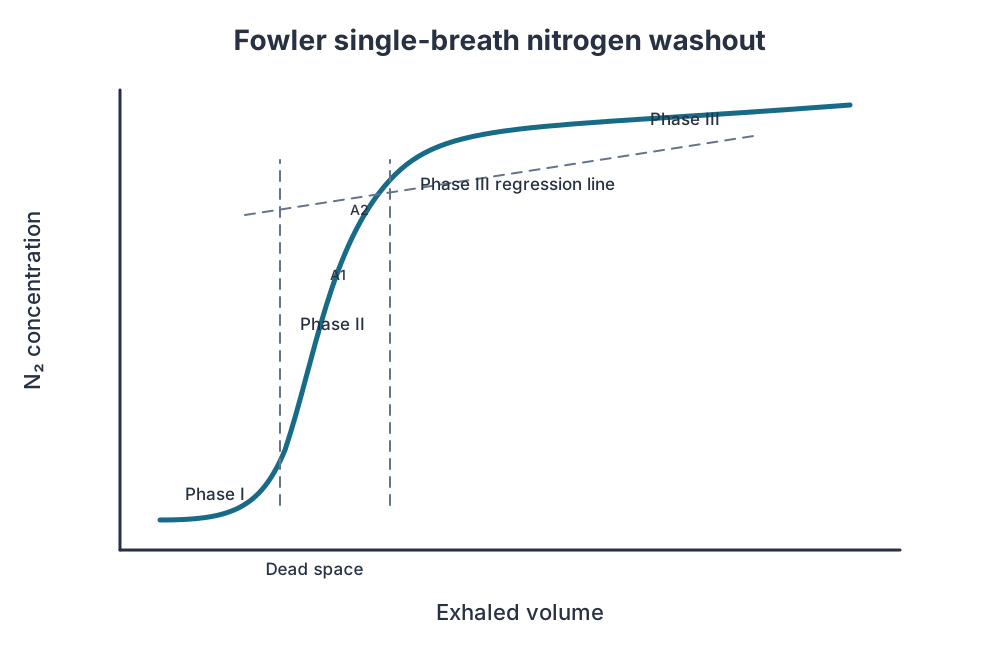
Measured by fowlers method (N2 washout)
Alveolar dead space
Dead space volume of parts of the respiratory airways that are ventilated but not perfused
West Zone 1 (PA > Pa)
Low cardiac output
Positive pressure ventilation
Posture
Disease states
Pulmonary Embolism
Measured by subtracting anatomical deadspace from physiological dead space
Physiological dead space
Alveolar + anatomical dead space
Calculated from Bohr equation
Normal arterial to end-tidal CO2 gradient is approx 5mmHg
Increases if increased dead space
Apparatus dead space
Dead space contributed by artificial airway devices (endotracheal tubes, LMA, HME filters)
Usually reduces anatomical deadspace (due to bypass of oropharynx)
Calculation / Measurement of Dead Space
Bohr’s Method
Bohr’s Equation:
Based on the principle that all CO2 exhaled must come from ventilated alveoli
PĒCO2 is mixed-expired CO2 in an expired tidal breath
Alveolar PCO2 is difficult to measure, so the Enghoff modification is used
which assumes PACO2 = PaCO2
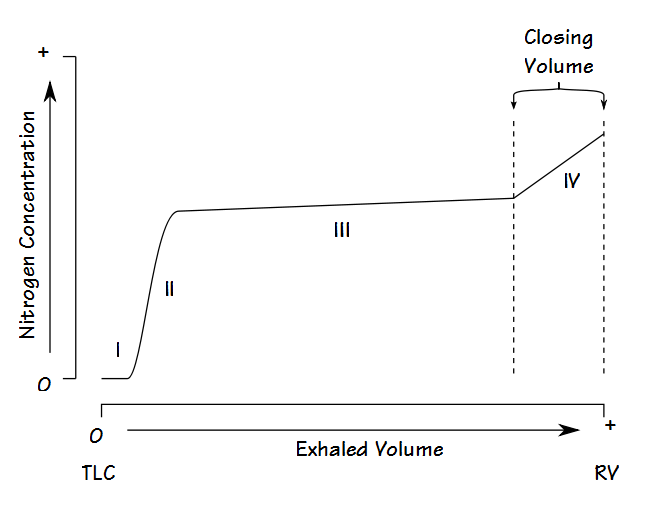
Fowler’s Method
Single-breath nitrogen washout test
Single Vital Capacity Breath – 100% O2 → Exhales to Residual volume
Expired Nitrogen concentration and volume is measured
Plot of concentration by volume generated
Phase I: Pure dead space. No Nitrogen present.
Phase II: Midpoint is volume of Anatomical dead space.
Phase III: Expired N2 plateaus
Phase IV: Closing capacity. Sudden Increase in Nitrogen.
(a) Define dead space and its components (15% of marks). (b) Describe the factors that affect each component (30% of marks). (c) Outline the physiological impact of increased dead space (15% of marks). (d) Describe methods of measurement of dead space (40% of marks).
Define dead space and its components (30% of marks). Explain how these may be measured (35% of marks) and describe the physiological impact of increased dead space (35% of marks).