Past Papers · SAQ
Viscoelastic Assays: Platelets, Heparin & Hyperfibrinolysis
2026A Q18
Exam questionWith respect to viscoelastic assays, describe the expected alterations and the underlying mechanisms resulting from the following:
a) platelet dysfunction (40% of marks),
b) therapeutic heparin use (40% of marks),
c) hyperfibrinolysis (20% of marks). Either TEG or ROTEM is acceptable for your answer.
CICMWrecks answer
Master answer
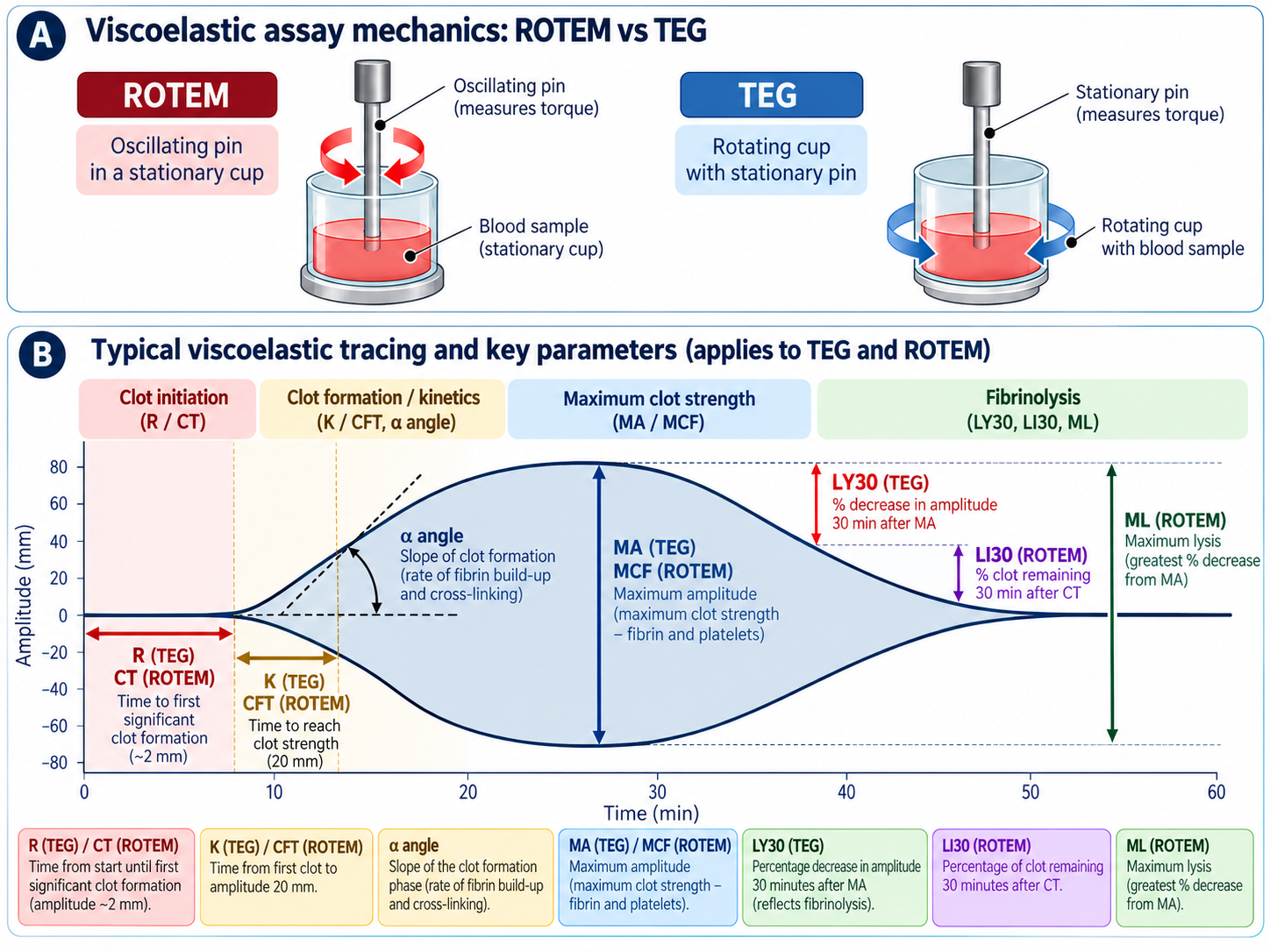
TEG / ROTEM parameter key
| Process | TEG | ROTEM |
|---|---|---|
| Clot initiation | R time | CT |
| Rate of clot formation | K time, α angle | CFT, α angle |
| Maximum clot strength / firmness | MA | MCF |
| Clot lysis | LY30 = % amplitude reduction 30 min after MA | LI30 = % clot firmness remaining 30 min after CT; ML = maximum % lysis |
Terminology note: TEG and ROTEM use different names for analogous properties: R ≈ CT, K ≈ CFT, and MA ≈ MCF.
a) Platelet dysfunction (40%)
| TEG / ROTEM feature | Expected change | Mechanism |
|---|---|---|
| R / CT | Usually unchanged | Initial fibrin generation is largely preserved because coagulation factor activity is intact. |
| K / CFT | Prolonged | Impaired platelet–fibrin interaction slows development of a firm clot. |
| α angle | Reduced | Slower increase in clot strength. |
| MA / MCF | Reduced | Platelets are a major determinant of maximal clot strength; dysfunction reduces clot firmness. |
| LY30 / LI30 / ML | Usually no primary fibrinolytic abnormality | Primary abnormality is clot strength, not fibrinolysis. |
b) Therapeutic heparin (40%)
Mechanism: heparin potentiates antithrombin, inhibiting thrombin and factor Xa (and other activated serine proteases) → slower fibrin generation and clot propagation.
| TEG / ROTEM feature | Expected change | Mechanism |
|---|---|---|
| R / CT | Prolonged | Delayed thrombin generation → delayed clot initiation. |
| K / CFT | Prolonged | Slower fibrin formation delays development of adequate clot strength. |
| α angle | Reduced | Rate of clot formation is reduced. |
| MA / MCF | Reduced | Reduced thrombin/fibrin generation produces a less firm clot. |
| LY30 / LI30 / ML | Usually no primary fibrinolytic abnormality | Heparin impairs coagulation rather than directly accelerating fibrinolysis. |
Useful confirmation: correction of the abnormal trace in a heparinase channel supports heparin as the cause.
c) Hyperfibrinolysis (20%)
| TEG / ROTEM feature | Expected change | Mechanism |
|---|---|---|
| R / CT | Often initially normal | Clot initiation may be preserved. |
| K / CFT | Often initially near normal | Early clot formation may still occur. |
| α angle | Often initially near normal | Initial clot propagation may be preserved. |
| MA / MCF | Initially preserved, then falls | The formed clot is progressively degraded. |
| LY30 | Increased | Greater percentage fall in amplitude measured 30 minutes after MA because fibrinolysis is accelerated. |
| LI30 | Decreased | Lower percentage of clot firmness remains 30 minutes after CT because fibrin is being broken down. |
| ML | Increased | Greater overall maximum clot lysis. |
| Trace appearance | Rapid narrowing after peak amplitude | Accelerated plasmin-mediated fibrin breakdown. |
One-line comparison
- Platelet dysfunction: normal R/CT, weak clot with ↓ MA/MCF and slower clot strengthening.
- Heparin: delayed R/CT, slower clot formation (K/CFT prolonged, α reduced) and reduced clot strength.
- Hyperfibrinolysis: clot forms, then breaks down too quickly with ↑ LY30 (30 min after MA), ↓ LI30 (30 min after CT), and ↑ ML.
Quick reference
Summary
| State | Key TEG / ROTEM pattern |
|---|---|
| Platelet dysfunction | R/CT preserved; K/CFT prolonged / α reduced; MA/MCF reduced |
| Heparin | R/CT prolonged; K/CFT prolonged; α reduced; MA/MCF reduced; heparinase correction supports diagnosis |
| Hyperfibrinolysis | Clot may form initially, then ↑ LY30 (30 min after MA), ↓ LI30 (30 min after CT) and ↑ ML |
Past papers
Exam appearances
| Exam | Exact exam wording | Candidate success |
|---|---|---|
| 2026A Q18 | With respect to viscoelastic assays, describe the expected alterations and the underlying mechanisms resulting from the following: a) platelet dysfunction (40% of marks), b) therapeutic heparin use (40% of marks), c) hyperfibrinolysis (20% of marks). Either TEG or ROTEM is acceptable for your answer. | 29% |