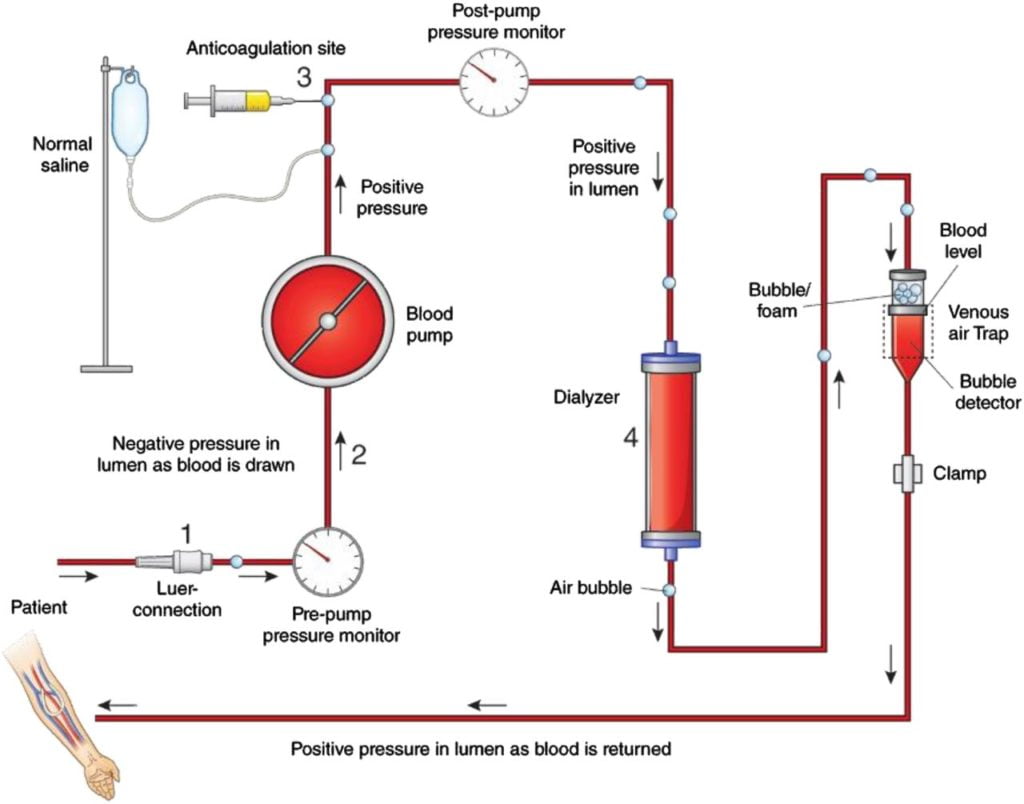
Describe the PHYSICAL PRINCIPLES that are involved in the flow of blood through a dialysis circuit, and, in the movement of solutes across a dialysis membrane.
CICMWrecks answer
Master answer
Dialysis
“process whereby the composition of a solution (patient’s blood) is altered by exposure to a second solution (dialysate) through a semi-permeable membrane”
involves transfer of H2O and LMWT solutes across the membrane between the solutions via diffusion, osmosis and solvent drag
Indications: Failure of normal renal functions, i.e.:
where, Q = Flow ΔP = pressure gradient r = radius η = Viscosity l = length
In a dialysis circuit, blood travels from the patient to a dialysis machine where it passes through a dialyser, allowing movement of fluid and plasma solutes across the membrane in either direction.
Flow across the circuit is determined by:
Set flow rate of centrifugal dialysis pump
parts of the circuit:
access port of vascular access (catheter / fistula / graft)
from patient (pre-membrane)
across membrane (trans-membrane)
to patient (post-membrane)
return port of vascular access (catheter / fistula / graft)
Assuming that machine delivers the flow which is set and the flow remains laminar and constant, the pressure across the various components varies based on the resistance.
The pressure gradient across the circuit depends upon:
characteristics of patient:
Blood viscosity
hematocrit
Blood protein and lipid content
Temperature changes changes flow and viscosity
Fåhræus–Lindqvist effect: Viscosity reduces in smaller diameter – because erythrocytes move over to the centre of the vessel/circuit, leaving only plasma near the wall of the vessel.
variable resistance during breathing or movement
collapsing vessels due to decreased vessel size / hypovolemia
antivoagulation used
characteristics of vascular access:
gauge and length of access
resistance from physical obstruction
resistance position
resistance from clots, fibrin
characetristics of circuit:
Age of circuit, presence of clots, fibrin
radius
length (usually constant ~3.5m)
surface coating of circuit
anticoagulation used
characteristics of membrane:
resistance worsens with clot, fibrin, lipid deposition
In some cases, resistance increases significantly, flow changes to turbulent, and dialysis machine may not be able to acheive set blood flow. (This usually activates some sort of alarm and will require quick troubleshooting)
As flow is set, the pressure across the various components varies based on the resistance
Physical Mechanisms of fluid and solute removal
Fluid removal Mechanisms:
Osmosis:
the movement of a pure solvent such as water, through a differentially permeable membrane, from a solution that has a lower solute (particle) concentration to one that has a higher solute concentration
The rate of osmosis depends on the concentration of solute, the temperature of the solution, the electrical charge of the solute and the difference between the osmotic pressures exerted by the solutions.
Movement across the membrane continues until the concentrations of the solutions equalise.
Ultrafiltration
the movement of fluid through a membrane caused by a pressure gradient (hydrostatic or osmotic pressure)
Uses both positive and negative pressure:
Positive pressure: pressure exerted by the blood flowing through the dialyzer, Results from blood being pushed by blood pump
Negative pressure: pressure applied to the dialysate side by the machine
Pulls excess fluid from blood compartment to dialysate compartment
Solute removal mechanisms:
Diffusion
the movement of solutes from a high to a low solute concentration across a semipermeable membrane
a concentration gradient is necessary for diffusion to occur
it removes all small molecules
the rate of diffusion is dependant on
surface area of filter
ratio of dialysate flow to blood flow
size of the molecules
Convection:
The movement of solutes with a water-flow “solvent drag” across a membrane during osmosis or ultrafiltration
Important for movement of small solute (urea, creatinine).
Adsorption:
when the molecules (solutes) adhere to the surface or interior of the membrane.
with the movement of fluid across the membrane, if no fluid is moving then adsorption can not occur.
in 2 manners:
surface adsorption where the molecules are too large to permeate and migrate through the membrane; however they can adhere to the membrane.
bulk adsorption occurs within the whole membrane where molecules can permeate it.
Molecules that can be effectively adsorbed include:
B2 microglobulin
Cytokines
Coagulation factors
Anaphylatoxins
The rate of movement of solute across the dialyzing membrane depends on
the concentration gradient of the solute between the two solutions,
the permeability of the membrane to the solute,
the surface area of the membrane, and
the length of time that the blood and fluid remain in contact with the membrane
Concentration gradient:
The concentration gradient is developed by using dialysate fluid with low concentration of solutes that are usually cleared by the kidney (eg; Na, K, PO4, urea, creatinine), in order to create a steep concentration gradient to encourage movement of these solutes from the blood to the dialysate.
The movement of blood and dialysate in different directions ensures this concentration gradient does not reach equilibrium and reduce further solute exchange.
Describe the PHYSICAL PRINCIPLES that are involved in the flow of blood through a dialysis circuit, and, in the movement of solutes across a dialysis membrane.