Explain perfusion limited and diffusion limited transfer of gases in the alveolus.
CICMWrecks answer
Master answer
Fick’s law of diffusion
Describes Diffusion through tissues
Rate of movement of solute across semi-permiable membrane J is
where
C = concentration (or partial pressure for gasses) A = cross-sectional area T = thickness of the membrane or distance over which diffusion takes place.
The rate of diffusion of a gas through a tissue is:
Directly ∝:
Surface area of the barrier Affected by:
Parenchyma volume: Changes with Body size and in disease states
V/Q mismatch: reduced in shunt and dead space
Pulmonary Blood Volume: changed with vascular distension and recruitment
Cardiac output: increased recruitment in high output states, decreased recruitment and increased V/Q mismatch in shock states
Posture: Increased surface area while supine (compared to sitting or standing)
Shift of oxygen dissociation curve (pH, temperature, PCO2, 2,3-DPG)
Haematocrit
Abnormalities of haemoglobin
Formation of carbamino compounds
Anaesthetic agents to plasma contents, e.g Albumin, cholesterol
Enzymatic Action
carbonic anhydrase (conversion of HCO3 to CO2)
Inversely ∝:
Membrane thickness
Increased thickness impedes gas exchange – Pathological states like pulmonary edema and cardiac failure
Square root of Molecular Weight
smaller substances diffuse more quickly
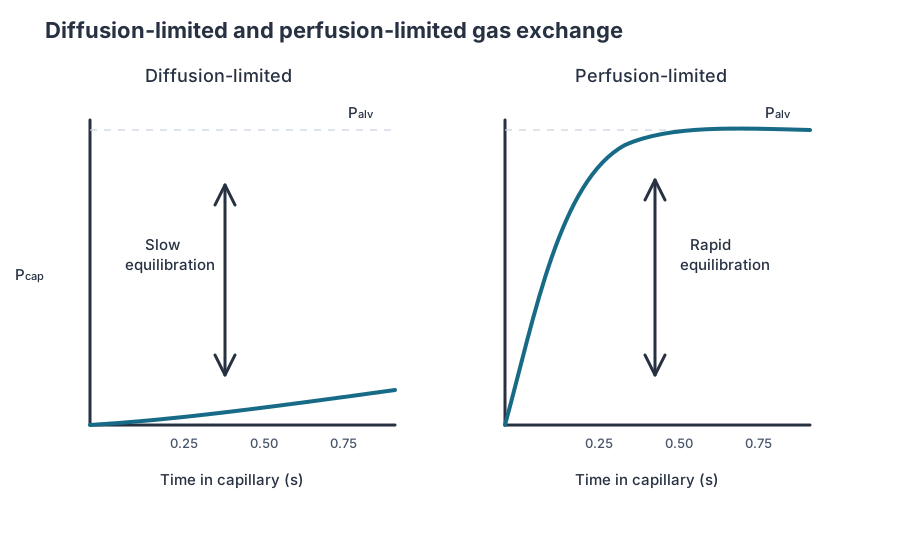
Diffusion vs. perfusion limited
Transfer of gases can be diffusion or perfusion limited dependent on the rate limiting step
Diffusion Limited
Occurs in gases which do not reach equilibration of Pa and PA
The rate of gas diffusion across the alveolar membrane limits its transport away from the lung
Rate limiting step = rate of diffusion
E.g. CO
CO binds so avidly to Hb (250x that of O2) → virtually no CO dissolved in plasma → PaCO rises only slightly
Even when RBC traversed entire length of pulmonary capillary, there is still substantial partial pressure difference across alveolar-capillary barrier → equilibrium of PaCO and PACO never reached
Perfusion Limited
Characterized by complete equilibration i.e. Pa = PA
amount of gas transferred between alveolus and capillary = dependent on amount of blood passing through the capillary
rate limiting step = rate of blood flow
E.g. N2O
N2O rapidly diffuses across alveolar-capillary barrier
Insoluble; does not bind to Hb; only carried in plasma in dissolved form
PaN2O = PAN2O (<0.07sec); well before RBC has traversed pulmonary capillary
↑ diffusion rate will not ↑ blood transport away from the lungs → limiting factor = rate of blood flow / perfusion
e.g. CO2 (ventilation limited i.e. perfusion limited in reverse)
CICMWrecks original diagram
Is the transfer of O2 perfusion or diffusion limited?
Can behave as both perfusion and diffusion limited
O2 diffusion takes 0.25s; pulmonary capillary transit time is 0.75s
Normal conditions
Transfer of O2 across the alveolar capillary barrier is perfusion limited
Equilibrium is reached between alveolar and capillary PO2 before the RBC has traversed the pulmonary capillary
Conditions where transfer of O2 may become diffusion limited
Disease of the alveolar capillary barrier
Pulmonary fibrosis: thickening of alveolar-capillary barrier → ↓ rate of diffusion
Exercise: ↑ CO → ↓ RBC transit time
Altitude: ↓ PaO2
Diffusion of O2 and CO2
Oxygen
Oxygen diffusion takes ~0.25s
Pulmonary capillary transit time is 0.75s
Therefore, under normal conditions oxygen is a perfusion limited gas
However, oxygen may become diffusion limited in certain circumstances:
Alveolar-capillary barrier disease Decreases the rate of diffusion.
Decreased surface area
Increased thickness
High cardiac output Decreases pulmonary transit time.
Altitude Decreases PAO2
Carbon Dioxide
Carbon dioxide is ventilation limited, rather than diffusion or perfusion limited
This is because it is:
20x more soluble in blood than oxygen
Rapidly produced from bicarbonate and carbamino compounds
Present in far greater amounts than oxygen 1.8L.kg-1 exist in the body (though 1.6L-1 of this are in bone and other relatively inaccessible compartments).
Impairment of diffusion capacity causes type 1 respiratory failure as oxygen is affected to a much greater extent than carbon dioxide