Describe how gas exchange is influenced across the placenta near the term of pregnancy.
CICMWrecks answer
Master answer
Diffusion via Fick’s Law
Flow of gas (Rate of movement of solute) across semi-permiable membrane J is
where
C = concentration (or partial pressure for gasses) A = cross-sectional area T = thickness of the membrane or distance over which diffusion takes place.
These factors alter the rate of transfer as per the equation above.
Valid for Most medium – small substances
Water soluble (H2O, electrolytes, glucose, urea) via intercelular clefts
Lipid soluble substances (O2, CO2) via endothelial cells themselves.
Flow = 1.2ml of O2 mmHg-1minute-1 across entire placenta
Surface area of placenta for diffusion = 16m2
Thickness of placental membrane falls as pregnancy progresses
Minimum thickness is 3.5 micrometres
Oxygen
Mean partial pressure of oxygen (PO2) in maternal blood is considerably higher than in fetal blood
As a consequence, oxygen readily diffuses across the placenta from maternal to fetal blood
Despite its low PO2, fetal blood is able to transport essentially the same quantity of oxygen to tissues as maternal blood
O2 Partial Pressure
Oxygen Content
Maternal
PaO2 = 100mmHg (80-110)
CaO2 = 16.1ml/100ml
Fetal Umbilical Vein
PvO2 = 30mmHg (30-50)
CvO2 = 16ml/100ml
Source: Diagram used in Placental transfer — Master Answer · Source/permission verification pending.
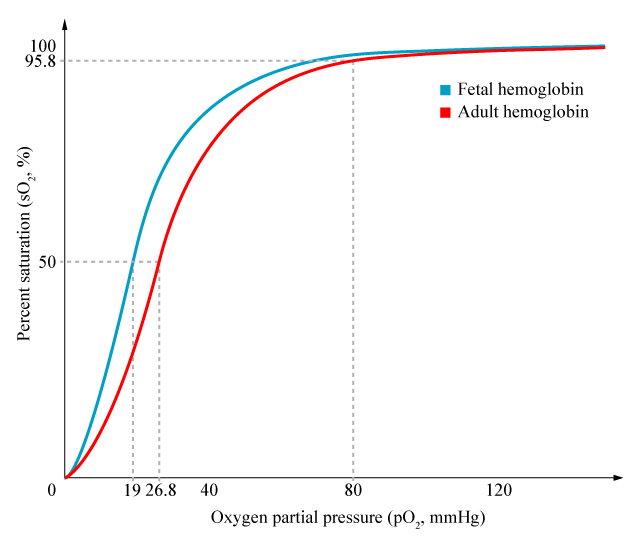
Foetal Hb has a higher affinity for O2 than maternal Hb
oxygen carrying capacity is improved, despite lower PaO2
P50 is 20mmHg vs 26 in maternal
Haemoglobin concentration in blood is higher in the foetus, increasing oxygen carriage
120g/L in mother
170g/L in foetus
Double Bohr effect:
Movement of CO2 from the foetal to the maternal circulation results in a simultaneous rise in maternal CO2 and fall in foetal CO2
Rise in foetal Hb oxygen affinity, fall in maternal Hb oxygen affinity by the Bohr effect
Carbon dioxide
Carbon dioxide is produced abundantly in the fetus
PCO2 of fetal blood is higher than maternal blood
Carbon dioxide therefore diffuses from fetal blood, through the placenta, into the maternal circulation, and is disposed of by expiration from the mother’s lungs.
O2 Partial Pressure
Maternal
PaCO2 = 32mmHg
Fetal Umbilical Artery
PvCO2 = 55mmHg
Hyperventilation in pregnancy (increased sensitivity of chemoreceptors to CO2) → Lower PaCO2
Smaller gradient than oxygen, but oxygen has 20 times higher solubility
Double Haldane effect:
Simultaneous rise in foetal Oxy-Hb and fall of maternal Oxy-Hb
Increased CO2 carrying capacity of maternal Hb, decreased in foetal Hb