Explain the difference between viscosity and density (10% of marks). Describe the effects of changes in viscosity and density on the flow of gases and liquids (90% of marks).
CICMWrecks answer
Master answer
DEFINITIONS
Viscosity (η)
Used to indicate a fluid’s internal resistance to flow. Also thought of as a measure of the friction of a fluid. e.g. honey has a high viscosity than water and as such moves much slower if poured
Density (ρ)
relates the mass of a substance to its volume such that ρ = kg/m3 Although some gases may have similar viscosity, their densities may be different (eg. O2 and He)
Flow
measure of volume of fluid / gas moved per unit of time (e.g. ml/min).
FLOW
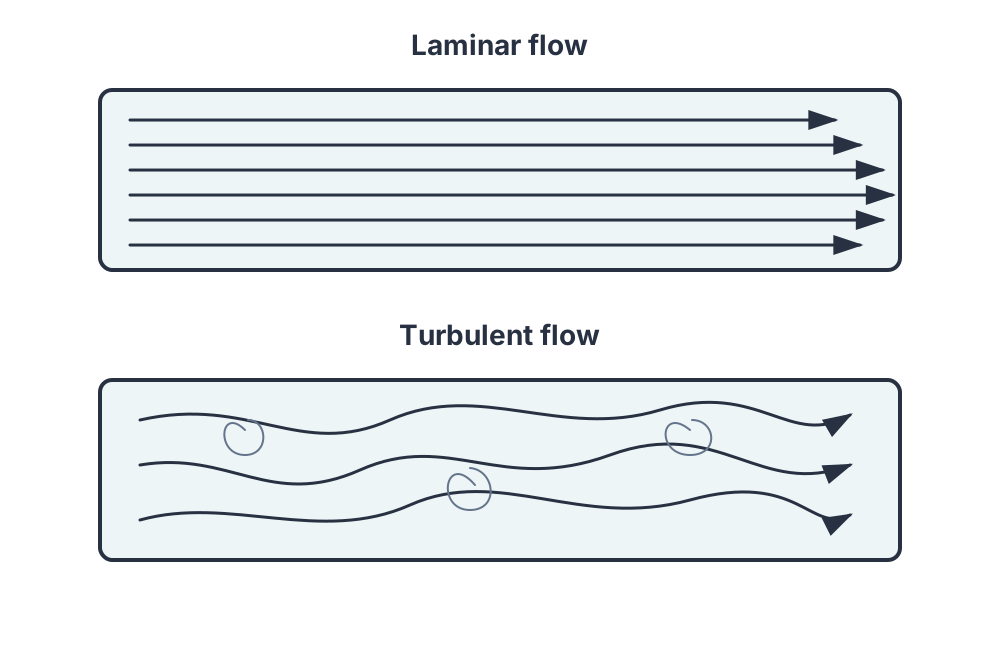
TYPES OF FLOW
Laminar
Turbulent
Transitional
CICMWrecks original diagram
Reynold’s Number
The Reynolds Number is defined as the ratio of inertial forces to viscous forces in a flowing fluid.
It is used in many fluid flow correlations and is used to describe the boundaries of fluid flow regimes (laminar, transitional and turbulent).
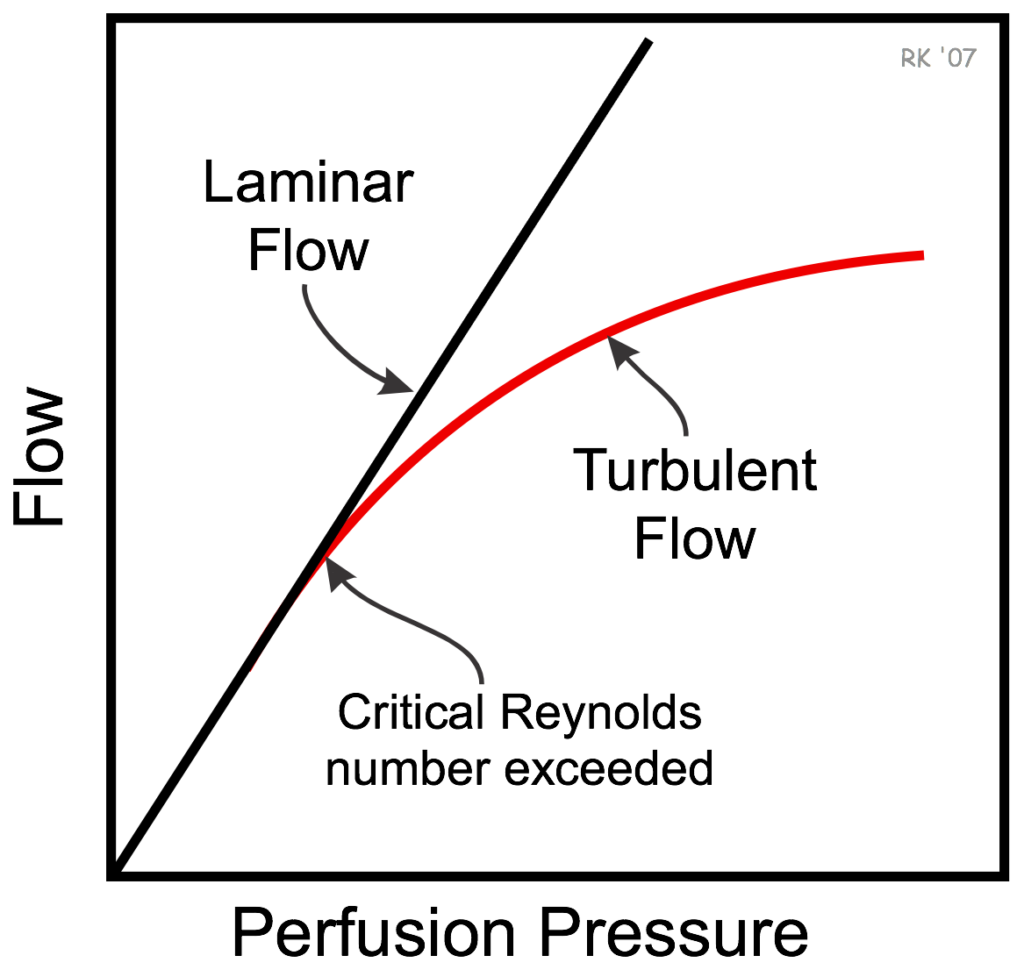
Reynold’s number can predict the likelihood of turbulent flow occurring.
where Re is Reynold’s number r is radius ρ is density v is velocity η is viscosity
Density (ρ) is the major determinant of Re: ↑ρ (N2 v He) → ↑prob of turbulent flow
Viscosity (η) has a much smaller contribution to the determination of Re: ↓η → ↑probability of turbulent flow
Laminar Flow
Laminar flow is the flow that corresponds with low velocities and Reynolds numbers less than 2300.
In this type of flow, the fluid flows in parallel layers, with no disruption between the layers.
At low enough velocities, the fluid will tend to flow without lateral mixing, while adjacent layers simply slide past one another
The movement of substance in the centre is twice the velocity of the movement of substance at the walls (there is no flow at the walls)
For flow to be laminar, the tube in which it is travelling must have smooth, parallel sides with no branches in the system
Resistance
(Hagan – Poisuelli Equation)
where R is vessel resistance η is viscosity L is length of vessel r is radius of vessel
Laminar Flow
where Q is Laminar Flow r is radius of vessel ΔP is pressure gradient η is viscosity L is length of vessel
There is a linear relationship between pressure and flow
Viscosity of the gas / fluid is directly proportionate to resistance:
↑η → ↑R → ↓flow
Density has no effect on the flow of gas during laminar flow
Altering the other variables will change R as seen
Turbulent Flow
Turbulent flow is the most common form of flow in nature, and corresponds to the Reynolds numbers higher than a value of 4000
chaotic and unpredictable, and is often seen with fluids at high velocities
undergoes irregular fluctuations, or mixing, and continuously changes magnitude and direction
Flow is disorganised with small eddies forming → creates a square wavefront
Resistance
where R is Resistance to flow ρ is density l is length of vessel r is radius of vessel
Turbulent Flow
where Q is flow ΔP is pressure gradient ρ is density l is length
Flow is inversely proportional to √ρ
Pressure is proportionate to flow2
Resistance proportional to density and not viscosity
Transitional Flow
Transitional or Transient flow is the phase of flow that occurs between laminar and turbulent flow, and corresponds to Reynolds numbers that land between 2300 and 4000.
In this type of flow, there is a mixture of laminar and turbulent flows present.
As Reynolds number increase from 2300 to ~4000, there are an increasing amount of disturbances appearing within the flow.
Transition can occur in either direction, that is laminar–turbulent transitional or turbulent–laminar transitional flow.
Explain the difference between viscosity and density (10% of marks). Describe the effects of changes in viscosity and density on the flow of gases and liquids (90% of marks).