Past Papers · SAQ
Mitochondria: Structure, Function & Metabolism
2025B Q16
Exam question(a) Outline the structure of mitochondria (20% of marks). (b) List the functions of mitochondria (20% of marks). (c) Explain the role of mitochondria in the metabolism of carbohydrates (60% of marks).
CICMWrecks answer
Master answer
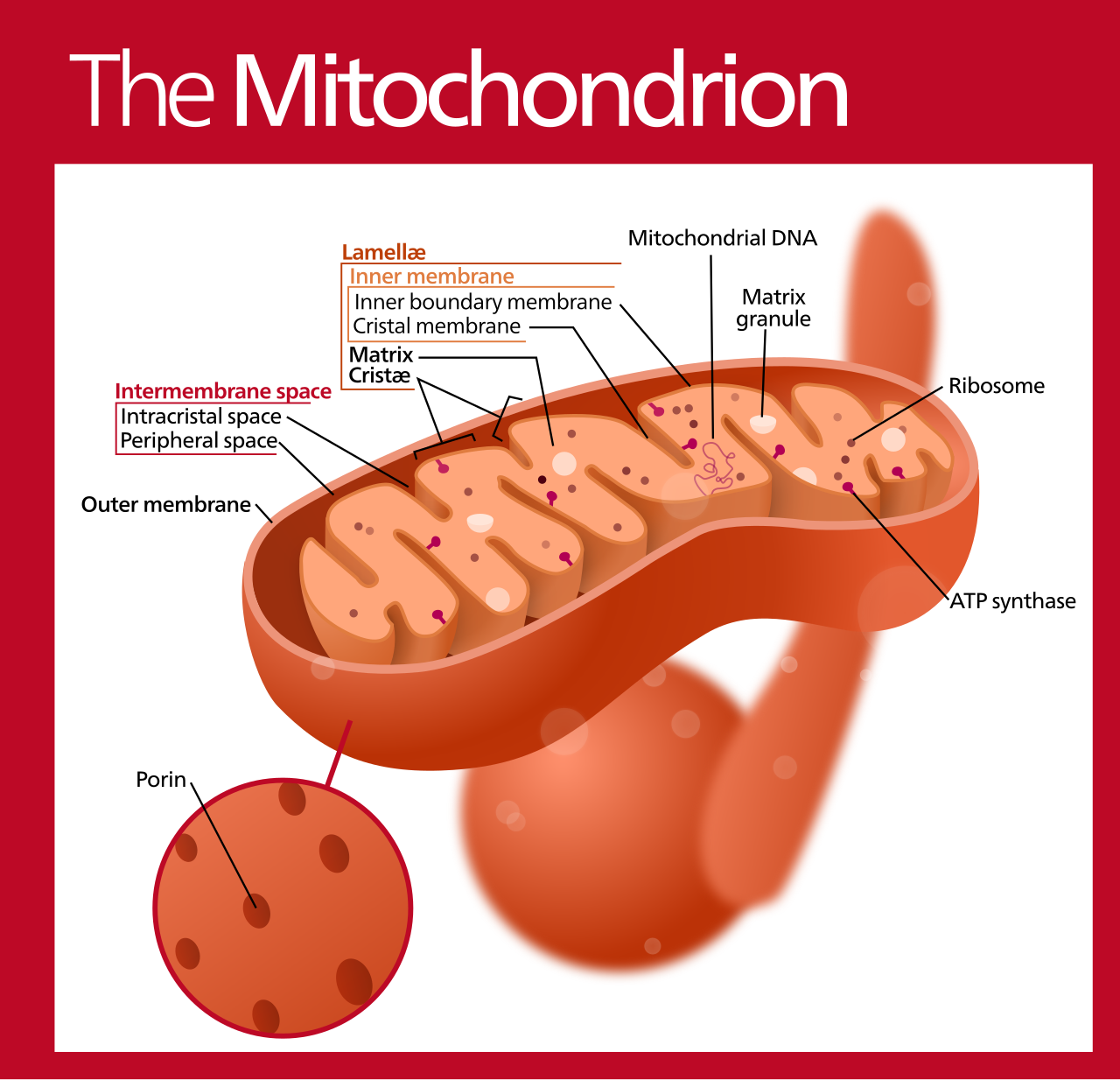
Structure
| Structure | Significance |
|---|---|
| Outer membrane | Contains porins; relatively permeable to small molecules |
| Intermembrane space | Receives H⁺ pumped by the electron transport chain, creating the proton gradient |
| Inner membrane | Highly selective; contains electron transport chain complexes, transporters and ATP synthase |
| Cristae | Folds of inner membrane that greatly increase surface area for oxidative phosphorylation |
| Matrix | Contains pyruvate dehydrogenase, TCA-cycle enzymes, mitochondrial DNA, tRNA and mitochondrial ribosomes |
- Mitochondria are usually ovoid intracellular organelles and are particularly numerous in metabolically active cells.
- They contain their own circular double-stranded mitochondrial DNA, predominantly maternally inherited.
- Most mitochondrial proteins are nevertheless encoded by nuclear DNA and imported into the organelle.
Functions
- ATP production by oxidative phosphorylation.
- Citric acid / TCA cycle.
- Fatty-acid β-oxidation.
- Apoptosis regulation.
- Ca²⁺ buffering and cellular calcium homeostasis.
- Thermogenesis through mitochondrial uncoupling, especially in brown adipose tissue.
- Reactive oxygen species generation and signalling.
- Parts of haem synthesis and steroid synthesis.
- Mitochondrial steps of the urea cycle.
Role in carbohydrate metabolism
1. Glycolysis supplies mitochondrial substrate
- Glycolysis occurs in the cytosol: glucose → 2 pyruvate + 2 ATP + 2 NADH.
- Pyruvate is transported into the mitochondrial matrix.
2. Pyruvate oxidation
- In the matrix, the pyruvate dehydrogenase complex converts pyruvate to acetyl-CoA + CO₂ + NADH.
- Acetyl-CoA then enters the citric acid cycle.
3. Citric acid / TCA cycle
- Occurs mainly in the mitochondrial matrix.
- Acetyl-CoA combines with oxaloacetate and is oxidised back to oxaloacetate.
- Each acetyl-CoA generates 3 NADH, 1 FADH₂, 1 GTP and 2 CO₂.
- The key energetic role is generation of NADH and FADH₂, which donate high-energy electrons to the respiratory chain.
- O₂ is not directly consumed by the TCA cycle, but continued cycle activity depends on regeneration of NAD⁺ and FAD by the electron transport chain.
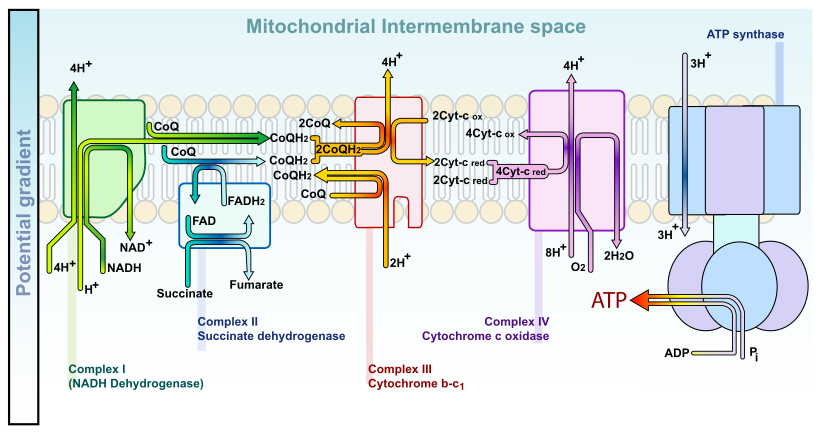
4. Electron transport chain
- Located in the inner mitochondrial membrane.
- NADH donates electrons to Complex I; FADH₂ donates via Complex II.
- Electrons pass via coenzyme Q → Complex III → cytochrome c → Complex IV.
- Complexes I, III and IV pump H⁺ from the matrix into the intermembrane space; Complex II does not pump H⁺.
- At Complex IV, O₂ is the terminal electron acceptor and is reduced to H₂O.
5. Oxidative phosphorylation
- H⁺ pumping creates an electrochemical proton gradient across the inner mitochondrial membrane.
- H⁺ returns to the matrix through ATP synthase.
- ATP synthase couples proton flow to ADP + Pi → ATP.
- Approximate modern yields are ~2.5 ATP per NADH and ~1.5 ATP per FADH₂.
- Complete aerobic oxidation of one glucose yields approximately 30–32 ATP, depending mainly on the shuttle used for cytosolic NADH.
Quick reference
Summary
| Stage | Site | Major result |
|---|---|---|
| Glycolysis | Cytosol | Pyruvate + ATP + NADH |
| Pyruvate oxidation | Matrix | Acetyl-CoA + NADH + CO₂ |
| TCA cycle | Matrix | NADH + FADH₂ + GTP + CO₂ |
| Electron transport chain | Inner membrane | Electron transfer → H⁺ gradient |
| ATP synthase | Inner membrane | H⁺ gradient → ATP |
| Final electron acceptor | Complex IV | O₂ → H₂O |
Past papers
Exam appearances
| Exam | Exact exam wording | Candidate success |
|---|---|---|
| 2025B Q16 | (a) Outline the structure of mitochondria (20% of marks). (b) List the functions of mitochondria (20% of marks). (c) Explain the role of mitochondria in the metabolism of carbohydrates (60% of marks). | 74% |