Past Papers · SAQ
Lymph: Composition, Circulation & Function
2025B Q13
Exam question(a) What is lymph and what is its normal volume? (10% of marks). (b) Outline the following with respect to lymph: (i) composition (20% of marks) (ii) circulation (45% of marks) (iii) functions (25% of marks)
CICMWrecks answer
Master answer
Definition and normal volume
- Lymph is interstitial fluid after it enters the lymphatic vessels.
- Normal lymph flow is approximately 2–3 L/day (about 2 mL/min at rest), and increases substantially with exercise and increased interstitial filtration.
Composition
Lymph is derived from interstitial fluid and therefore resembles interstitial fluid more closely than plasma.
| Component | Lymph compared with plasma |
|---|---|
| Water / electrolytes | Broadly similar electrolyte composition |
| Protein | Lower overall, but highly tissue-dependent |
| Cells | Mainly lymphocytes; also macrophages / antigen-presenting cells |
| Platelets | Essentially absent |
| Clotting proteins | Present in small amounts; low fibrinogen |
| Lipid | Variable; intestinal lymph becomes rich in chylomicrons after fat absorption |
Regional variation
- Hepatic lymph: relatively protein-rich because hepatic sinusoids are highly permeable to protein.
- Intestinal lymph: fat-rich after meals because lacteals absorb chylomicrons.
- Peripheral tissue lymph is generally lower in protein.
Circulation
Formation
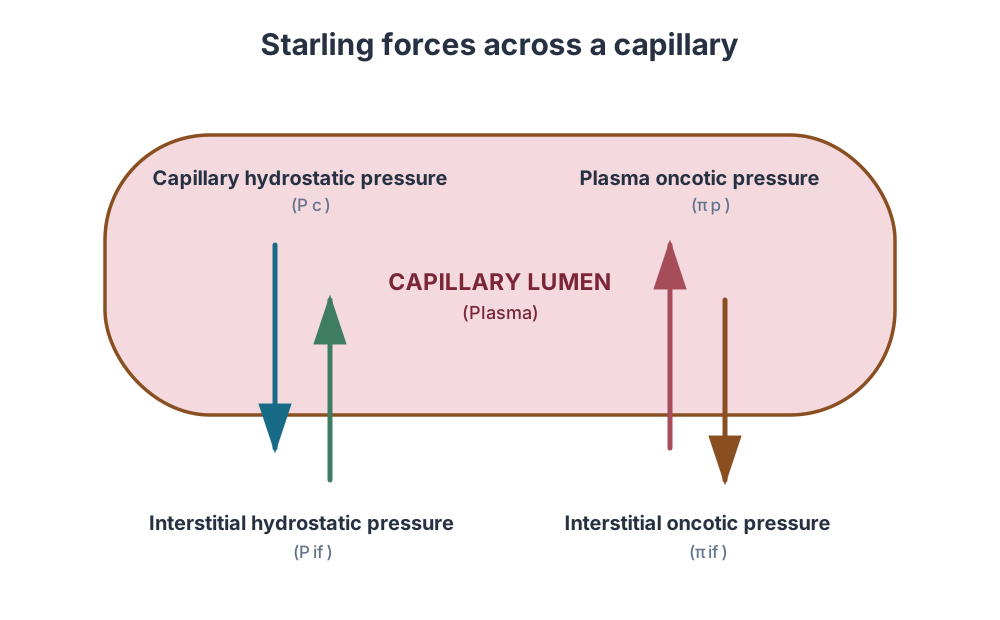
Fluid moves from capillary plasma into the interstitium according to Starling forces. Net capillary filtration produces interstitial fluid; excess fluid and escaped protein are returned through the lymphatic system.
Jv = fluid flux; κ = filtration coefficient; P = hydrostatic pressure; π = oncotic pressure; σ = protein reflection coefficient. Open in Formula Library
Entry into lymphatics
- Initial lymphatic capillaries are thin-walled, blind-ending vessels.
- Overlapping endothelial cells act as one-way flap valves.
- Rising interstitial pressure and anchoring filaments open the flaps.
- Fluid, protein and larger particles can therefore enter lymphatic capillaries.
Pathway
Interstitial fluid → lymphatic capillaries → collecting lymphatics → lymph nodes → lymphatic trunks → lymphatic ducts → systemic veins.
- Thoracic duct: drains both lower limbs, abdomen, left thorax, left upper limb and left head/neck; enters the venous circulation near the junction of the left internal jugular and subclavian veins.
- Right lymphatic duct: drains the right head/neck, right upper limb and right thorax; enters at the right venous angle.
Factors promoting lymph flow
- Intrinsic contraction of lymphatic smooth muscle.
- Skeletal muscle contraction.
- Respiratory pressure changes.
- Arterial pulsation and external tissue compression.
- One-way valves prevent backflow.
Functions
1. Return of excess interstitial fluid
- Returns net-filtered fluid to the vascular circulation.
- Failure of lymph drainage causes interstitial fluid accumulation and oedema.
2. Return of interstitial protein
- Collects protein that has escaped from plasma and returns it to the circulation.
- This limits accumulation of interstitial protein and helps maintain tissue fluid balance.
3. Absorption and transport of fat
- Intestinal lacteals absorb dietary long-chain lipid as chylomicrons.
- Chyle enters the thoracic duct and then the systemic circulation, initially bypassing the portal circulation.
4. Immune function
- Transports lymphocytes, antigen-presenting cells and antigens.
- Lymph nodes filter lymph and facilitate macrophage activity and adaptive immune responses.
Quick reference
Summary
| Area | High-yield point |
|---|---|
| Definition | Interstitial fluid within lymphatic vessels |
| Flow | ~2–3 L/day |
| Formation | Net capillary filtration from Starling forces |
| Composition | Similar to interstitial fluid; less protein than plasma overall |
| Regional differences | Liver = protein-rich; gut = chylomicron-rich |
| Drainage | Thoracic duct + right lymphatic duct → venous circulation |
| Flow drivers | Muscle, respiration, arterial pulsation, intrinsic contraction, valves |
| Functions | Fluid return, protein return, fat absorption, immunity |
Past papers
Exam appearances
| Exam | Exact exam wording | Candidate success |
|---|---|---|
| 2025B Q13 | (a) What is lymph and what is its normal volume? (10% of marks). (b) Outline the following with respect to lymph: (i) composition (20% of marks) (ii) circulation (45% of marks) (iii) functions (25% of marks) | 69% |