Past Papers · SAQ
Coronary Circulation
2026B Q13
Exam questionWith respect to the adult coronary circulation:
a) State the normal resting coronary blood flow, including appropriate units (5% of marks)
b) Describe the anatomy of the coronary arteries including the regions of the heart they supply (20% of marks)
c) Describe the flow characteristics of the coronary arteries (15% of marks)
d) Briefly outline the venous drainage of the myocardium (10% of marks)
e) Describe the regulation of coronary perfusion (50% of marks)
CICMWrecks answer
Master answer
Arteries
- LCA to
- LCx to
- OM1
- OM2
- LAD has branches
- Diagonal 1 or 2
- LCx to
- RCA
- Right Ventricular
- Acute Marginal
- Posterior descending
Veins
- Great, small, middle
- Drain into the thebesian veins → ventricles directly
- Empty into the coronary sinus on the posterior wall or the RV
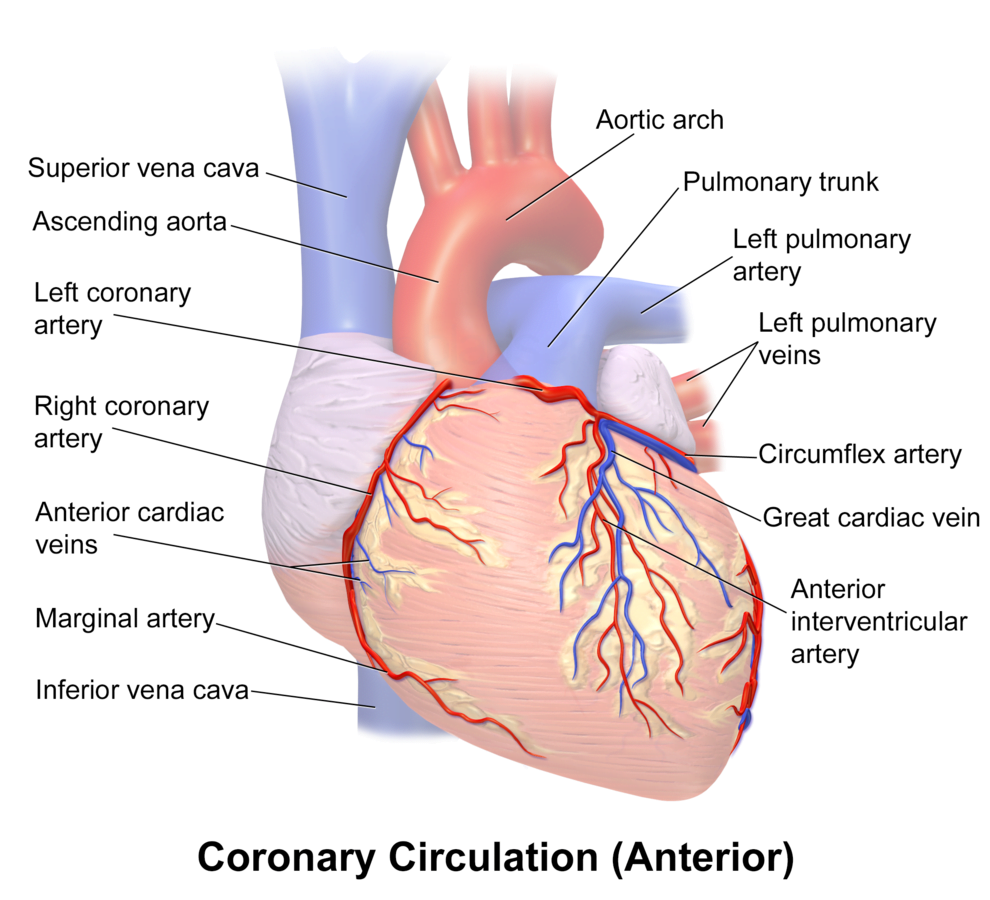
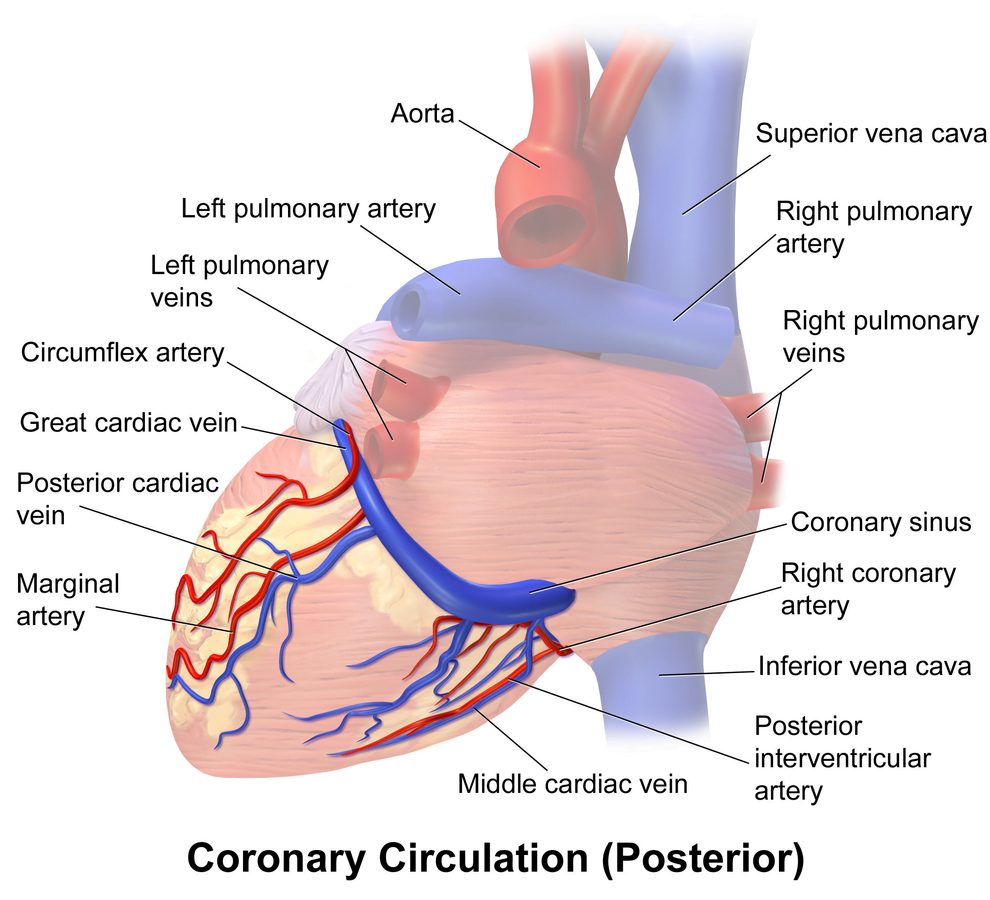
Regional Supply
| Artery | Anatomical region | ECG abnormality on occlusion |
|---|---|---|
| RCA | Down Anterior aspect of the heart, right of the pulmonary trunk Supplies RA SAN and AVN Posterior IVS | RCA occlusion causes → inferior: 2,3 aVF → true posterior: tall R in V1 |
| LCA | Left coronary artery ostia adjacent to left leaflet → Left Main → LCx and LAD Supplies LA, LV IVS AV Bundles | LCA occlusion → Lateral: 1, aVL, V1-V6 |
| LCx | LA and superior LV | anterolateral leads (1, aVL, V5 and V6) |
| LAD | RV, LV Anterior 2/3rds Interventricular Septum | Anteroseptal (V1 and V2) Anteroapical (V3 and V4) with some RCA supply. |
| Left Marginal | The continuation of the LCA after LAD branch Supplies LV laterally | Isolated Abnormalities rare V5, V6 |
| Right Marginal | The anterior branch of the RCA along the inferior border Supplies right ventricle and apex | Isolated Abnormalities rare RCA occlusion causes 2,3 aVF |
Coronary Blood Flow
- 80 mL/min/100 g
- or 200-250 mL/min
- 5% of CO at rest
- Can increase by 3-4 times (up to 400mL/min/100g)
High Extraction Ratio
High at rest (55-65%) body average of 25%
- Extraction ratio can only rise by factor of < 2 to 90%
- AV Δ O₂ = 11 mL/dL
- Coronary venous O₂ content = 5 mL/dL
- Coronary sinus SpO₂= 20mmHg
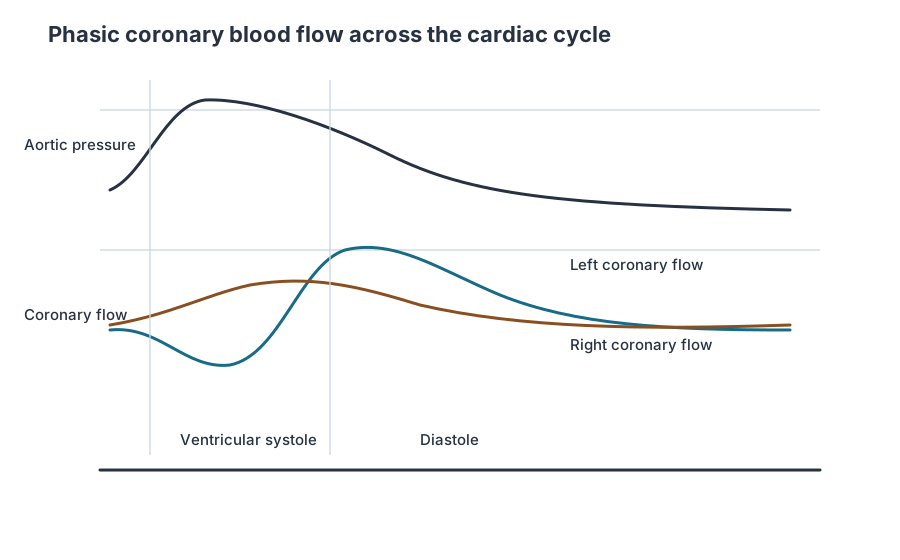
Coronary perfusion pressure (CPP)
- ADP = Ao Diastolic Prssure
- It is different throughout the cycle and b/w ventricles
Phasic Supply as per diagram.
Determinants of Coro BF
- Physical Factors
- Extravascular compression (CPP factors)
- Neural and Neurohumoral Factors
- ↑ SNS tone →
- α receptor mediated vasoconstriction
- β receptor mediated vasodialtion
- ↑ force and rate of contractions → ↑ vasodialtor metabolite release
- Overall effect is dilation
- ↑ PSNS tone → KACh stimulation → mild ↓ Coronary vascular resistance
- ↑ SNS tone →
- Metabolic Factors (main)
- Vasodilatory
- ↑ Adenosine, H, K, CO2, Lactate
- NO → GTP
- ↑ O2 demand → ↓ ATP → ↑KATP channel activation → hyperpolarisation → vasodilation
- Vasodilatory
- Myogenic autoregulation (keep CPP 60-180 mmHg)
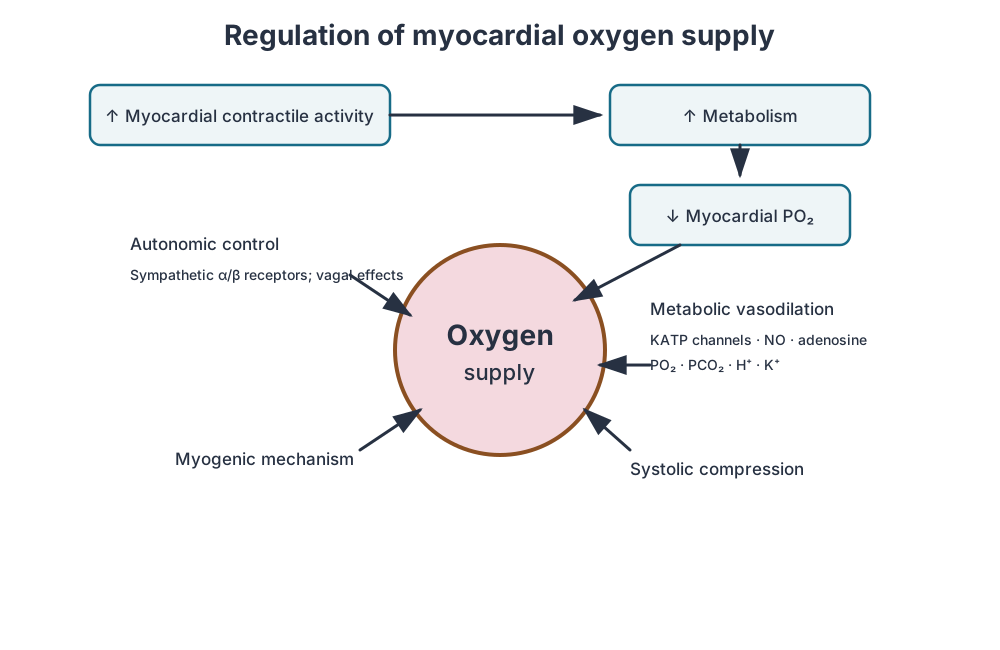
Gladwin 2016
Reusable content
1
Formulae used in this answer
Quick reference
Summary
| Coronary circulation | Key point |
|---|---|
| Resting flow | ≈250 mL/min, about 4–5% of cardiac output (≈70–80 mL/100 g/min) |
| Anatomy | RCA and LCA arise from aortic sinuses; LCA → LAD + circumflex; dominance defined by origin of PDA |
| Flow | LV coronary flow is predominantly diastolic because systolic myocardial compression impedes flow; RV flow is more continuous |
| Venous drainage | Mostly via coronary sinus to RA; anterior cardiac and Thebesian veins provide additional drainage |
| Regulation | High resting O2 extraction means increased demand is met mainly by increased flow; local metabolic control dominates (adenosine, hypoxia, K+, H+, CO2, NO) with autoregulatory and neural modulation |
Past papers
Exam appearances
| Exam | Exact exam wording | Candidate success |
|---|---|---|
| 2026B Q13 | With respect to the adult coronary circulation: a) State the normal resting coronary blood flow, including appropriate units (5% of marks) b) Describe the anatomy of the coronary arteries including the regions of the heart they supply (20% of marks) c) Describe the flow characteristics of the coronary arteries (15% of marks) d) Briefly outline the venous drainage of the myocardium (10% of marks) e) Describe the regulation of coronary perfusion (50% of marks) | — |
| 2023A Q15 | Describe the adult coronary circulation (50% of Marks) and its regulation (50% of Marks). | 66% |
| 2021A Q19 | Describe the adult coronary circulation (50% marks) and its regulation (50% marks). | 62% |
| 2018A Q11 | Describe the regulation of the coronary circulation. | 46% |
| 2014B Q10 | Describe the adult coronary circulation (50% of marks) and its regulation (50% of marks). | 65% |
| 2008B Q11 | Describe the adult coronary circulation (50% of marks). Describe the physiological control of the coronary circulation (50% of marks). | — |