Describe how interstitial fluid recirculates to the vascular system
CICMWrecks answer
Master answer
Interstitial fluid:
Interstitial fluid provides the immediate microenvironment that allows for movement of ions, proteins and nutrients across the cell barrier.
In the average male (70 kg) human body, the interstitial space has approximately 10.5 litres of fluid.
This fluid is not static, but is continually being refreshed by the blood capillaries and recollected by lymphatic capillaries.
Summary of drainage:
The blood and lymphatic vasculatures constitute two parallel circulatory organs, connected by the emptying of lymph into the venous system.
Blind-ending lymphatic capillaries collect interstitial fluid by pumping the liquid, which will pass lymphatic valves that close to prevent ‘back-flow’.
Tissue oedema facilitates the draining of the interstitial fluid through the initial lymphatic vessels by pulling on the vessels through their tissue-anchored filaments
Approx. 24L fluid filtered / day
85% reabsorbed into capillaries
Rest reabsorbed via lymphatics (~3.5L/day) = Net fluid loss from filtration
Anatomy of Veins:
Veins are thin-walled, being thinner and larger than the arteries.
Veins have valves which maintain the unidirectional flow of blood, even against gravity.
The muscular and elastic tissue content of the venous walls is much less than that of the arteries. This is directly related to the low venous pressure.
Since the venous pressure is low (7 mm Hg) the valves are of utmost value in the venous return.
However, the valves are absent in:
The veins of less than 2 mm diameter.
The venae cavae.
The hepatic, renal, uterine, ovarian (not testicular), cerebral, spinal, pulmonary, and umbilical veins.
Large veins have dead space around them for their dilatation during increased venous return. The dead space commonly contains regional lymph nodes.
Vascular permeability:
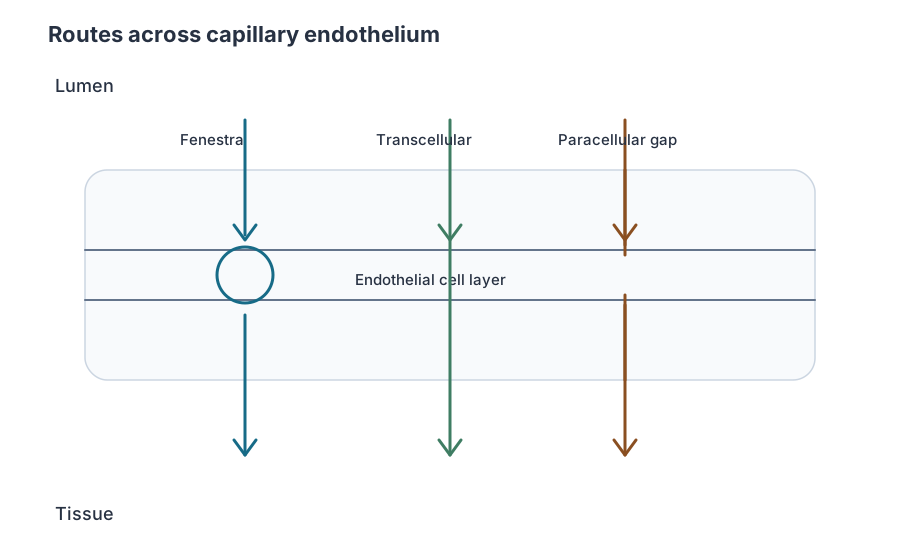
Vascular permeability, often in the form of capillary permeability or microvascular permeability, characterizes the capacity of a blood vessel wall to allow for the flow of small molecules (drugs, nutrients, water, ions) or even whole cells (lymphocytes on their way to the site of inflammation) in and out of the vessel.
Blood vessel walls are lined by a single layer of endothelial cells. The gaps between endothelial cells (cell junctions) are strictly regulated depending on the type and physiological state of the tissue.
Vascular permeability is Regulated by Angiogenic growth factors (VEGF) and Inflammatory cytokines (histamine, bradykinin).
Vascular permeability is affected in disease states like cancer, MI, Sepsis.
Anatomy of Lymph:
Lymph is the name given to interstitial fluid which enters the lymphatic vessels.
Lymphatic capillaries are present in nearly all tissues.
Significant exceptions are the central nervous system and bone.
Small interstitial channels are present in the brain and the fluid flows into the CSF and then passes back into the circulation via the arachnoid villi.
The lymph capillaries are blind-ending and possess flap valves between adjacent lymphatic endothelial cells.
These functional valves permit entry of ISF but prevent its return to the interstitium.
The pressure inside the lymph capillary is about 1 mmHg at rest and the flap valves are closed.
The lymph capillaries interconnect and join together to form lymph venules, and then large lymph veins which drain via lymph nodes into the thoracic duct (on the left) and the right lymphatic duct.
By these two final pathways, lymph returns into the circulation.
Role of Forces:
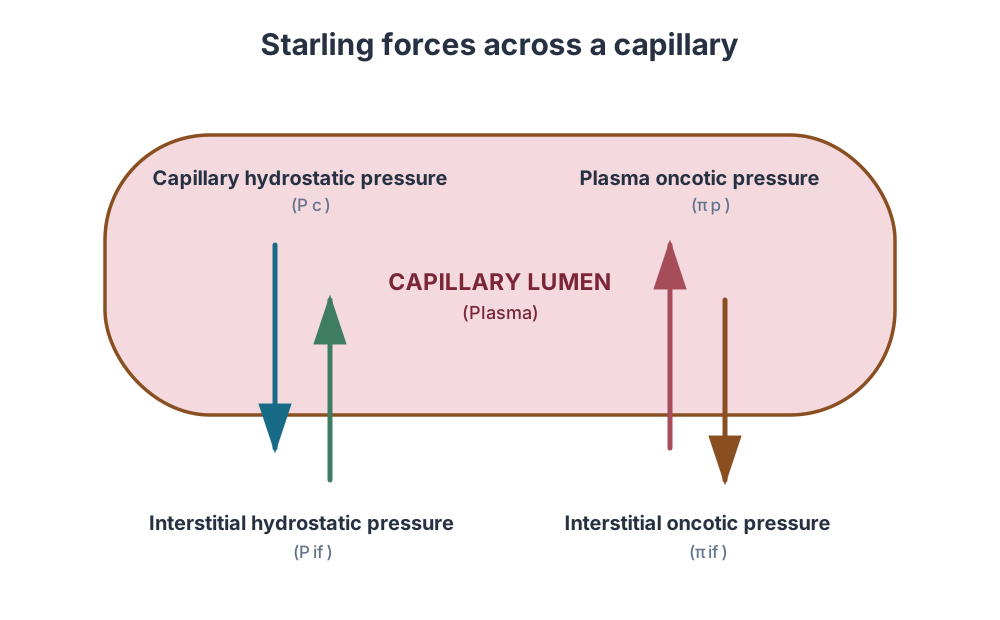
Starling Forces (Osmotic and Hydrostatic)
The NET flux across the membrane is the balance of hydrostatic pressure and oncotic pressure, as defined by the Classic Starling Equation:
where Jv is the trans endothelial solvent filtration volume per second ( [ Pc – Pi ] – σ [ πp – πi ] ) is the net driving force P = hydrostatic pressure π = oncotic pressure σ = Staverman’s reflection coefficient ie. Permeability of membrane to protein κ = filtration constant = LpS = Hydraulic conductivity x Surface Area
Typically quoted values for the variables in the classic Starling equation:
Hydrostatic pressure
Oncotic pressure
Pressure moving fluid
pressure exerted by proteins which draw water into and keep it within a compartment
Pc ~35 → 15mmHg (Arterial → venous) Capillary hydrostatic pressure Pressure moving fluid out of capillary
πif ~ 0mmHg Interstitial fluid oncotic pressure Pressure keeping fluid out of capillary
In general,
at the arterial end of capillary NFP is positive (filtration) +10mmHg
At the venous end NFP is negative (absorption) -10mmHg
Approx. 24L fluid filtered / day
85% reabsorbed into capillaries
Rest reabsorbed via lymphatics (~3.5L/day) = Net fluid loss from filtration
Electric forces:
The ionic composition of the interstitial fluid and blood plasma vary due to the Gibbs–Donnan effect [“Opposing osmotic and electro-chemical gradients in the presence of a non–diffusable ion resulting in unequal distribution of the diffusable ions”]
This causes a slight difference in the concentration of cations and anions between the two fluid compartments.